Sunday, 1 December 2002

WINTER HARP

Winter Harp plucks up the spirit of the season!


WINTER HARP
Thursday, December 12, 2002
MacEwan Ballroom (U of C)

Combining medieval Christmas carols with their own vibrant musical compositions, Winter Harp is a Vancouver-based troupe of troubadours that performs and records music using painstakingly reconstructed traditional medieval instruments.

The heavenly reverberations of the classical Spanish and Celtic harps, plucked by multiple-award winners Lori Pappajohn and Jill Whitman, have a commanding presence. Lauri Lyster is Winter Harp’s heartbeat, providing what Pappajohn refers to as "the oldest source of music" – percussion – while Joaquin Ayala and Kenichi Ueda augment the company’s 190 strings with flute, bells and chimes. Poet and performer Alan Woodland animates each show with tales of winter that, according to Pappajohn, are carefully selected for their ability to tug at your heartstrings. They signal that the Yuletide has truly begun.

"Winter Harp gets together in the fall to plan out our next show," says Pappajohn. "We have a hard time deciding what not to include. Alan Woodland travels to England every summer and visits libraries to do research for us on Christmas and winter. He comes up with so many wonderful pieces of literature. No matter how often I hear some of them, they can still bring tears to my eyes."

Resurrecting music that in some cases has gone unheard for centuries is no easy task, but Pappajohn and her associates have discovered that having authentically crafted instruments to perform with makes that music sound even better. Her first inspiration for the customized construction of a specialty medieval replica was the bass psaltery, a haunting instrument with ancient roots.

"The bass psaltery goes back thousands of years," says Pappajohn. "The Sumerians and Babylonians used them. I have one bass psaltery that is about a foot-and-a-half tall. And I thought, ‘Wouldn’t this sound fantastic if it was five feet tall?’ So I went to the best instrument crafter in Canada, a man named Edward Turner, and he laughed at me like I was crazy. But I said, here’s the deal – I’ll pay you. So he made it for me. It’s a five-foot obelisk and the sound it produces is amazingly ethereal. I can only describe it as the sound of sunlight shimmering on the surface of water."

Her next flash of creative genius came when Turner showed her a picture of one of his other original creations, the organistrum. Far from the grating trumpet of its sister crank-handle machine the hurdy-gurdy, the organistrum’s four bowed-up strings have a more harmonious disposition. Its deep tonal voice originated in 12th century Spain and then migrated across Western Europe. Turner copied Gothic cathedral sculptures to perfect his design – there are only two such instruments in existence in the world (the other hangs in the Canadian Museum of Civilization in Ottawa).

"I was ordering my bass psaltery and Ted said, ‘By the way, I made one of these, too.’ The picture was so breathtaking that without even hearing it I said, ‘I’ll take one.’"

For Pappajohn, the realization was beginning to set in that there were dozens of "lost instruments" out there waiting to be rediscovered. Looking at the Christmas carols we all know by rote, she points out that we are reciting lyrics that were written two, three or four hundred years ago. Taking people back to that long-forgotten time has become the theme of Winter Harp’s mystical performances and recordings. Clad in Pre-Raphaelite gowns and surrounded by candles, the members of the ensemble embody the spirit of the season, and convey its message of good will through cheerfully interactive songs and stories.

"We focus on the myth and legend surrounding the darkest time of the year, when people traditionally gather," says Pappajohn. "The Celtic bonfire festivals were an opportunity for everyone to share warmth, companionship, their hopes for the return of the sun, and the coming new year. For centuries it’s been a time when people pause and examine their lives…. There is a time of darkness within all of us that anticipates the returning, the rebirth. For us, it’s a journey. Whether you believe the Christmas story or treat it as a fable, it’s a fun and magical time of year for all."

Winter Harp has recently received a grant from Bravo, which has allowed the troupe to produce its first music video, entitled "Avalon." Filmed on location in England in the pouring rain, "Avalon" will be in rotation on Bravo and is also available (along with more information about Winter Harp) on the group’s Web site, www.winterharp.com.

By Christine Leonard

Wednesday, 10 July 2002

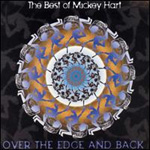
The Best of Mickey Hart: Over the Edge and Back - Album Review

Mickey Hart
The Best of Mickey Hart: Over the Edge and Back(Rykodisc)

Cover Art

By Christine Leonard
Jul 10, 2002

Percussionist/composer/producer/author/ethnomusicologist Mickey Hart, former drummer of The Grateful Dead, presents Over the Edge and Back, a retrospective spanning 25 years of musical experimentation and exploration. Gathering together previously recorded materials, Hart re-encapsulates the essence of his artistic odyssey into one dynamic audio-showcase. This "Best of-" compilation opens with the song taken from Hart's most recent new-age release Supralingua, "Angola", an evocative instrumental track which signals to the listener that they aren't in Kansas anymore. 


Carrying on from there, the disc flows into the seductive and optimistic "Where Love Goes" sung by the London-based group The Mint Juleps. I do declare, that this is one beauty of a track, with pure vocals and an African sway to it. Drawing on a lifetime of experience, Hart has rounded up a collection of diverse material from his numerous solo and collaborative performances around the world. One of these significant side-projects is known as Diga, a self-described 20th-century rhythm orchestra. 


Featuring the lightning-quick beats of tabla virtuoso Zakir Hussain, Diga is the source of the album's fourth track "Sweet Sixteen." Another compelling cut entitled "The Compound" was one of many Hart composed for the percussion-based soundtrack to Francis Ford Coppola's Apocalypse Now. Turning his studies ever inward, Mickey Hart has taken the shaman's path to spiritual enlightenment, as documented in his memoirs "Drumming at the Edge of Magic" and "Planet Drum," and the complementary CDs that accompanied them. 


Indeed, the theme of this new album is very much in keeping with Hart's visionary quest to conjure the ancient metaphysical roots of his musical soul.

RECOMMENDED TRACKS: "Where Love Goes", "Call To All Nations"


Christine Leonard, CJSW Radio, Calgary, AB


Friday, 1 March 2002

MEDIAEVAL BAEBES

Is that a lance in your pocket?
If so, the Mediaeval Baebes 
will be happy to see you!

MUSIC PREVIEW
MEDIAEVAL BAEBES
Friday, March 10, 2002
MacEwan Hall (U of C)

Former leader of the legendary goth band Miranda Sex Garden, Katharine Blake and her troupe of bewitching troubadours breathe new life into Europe’s oldest music. Borrowing in good faith from medieval literary sources, Blake arranges ancient sonnets and prose into workable 21st century melodies.

Formed in London in 1996, the Mediaeval Baebes originally consisted of a dozen women from around the globe who were drawn to each other by a shared love of art, music, theatre and drinking. Combined with their angelic voices,the group’s sensuous image, which incorporates intricately braided tresses and sinfully sheer floor-length gowns, quickly captured the interest of British record companies.

Three top-selling albums later the Mediaeval Baebes have reduced their handsome headcount to a mere nine singers: Blake, as well as fellow Miranda Sex Garden alumnus and Hamilton, Ontario native Teresa Casella, Marie Findley, Claire Ravel, Rachel Van Asch, Carmen Schneider, Ruth Galloway, Bjork’s doppelganger Audrey Evans and – who could forget? – Cylindra Sapphire. Though their numbers may have diminished, the balance and range of their vocal harmonies has not. The nine sisters recorded their latest offering and named it after the romantic symbol of perfect love, The Rose, and included a stunning booklet of gorgeous goth-nouveau artwork and intimate portraits of each Baebe in full anachronistic regalia.

"I think this is our most ambitious project to date," says Blake. "On our other albums we weren’t able to be a part of the whole process. We wanted to see this new one through from beginning to end, to really take responsibility for the final product. It was a great experience, we were able to bring in friends of ours who are musicians, and photographers, and artists."

Rounding out the wild wench entourage is accomplished musician and honorary Baebe, Dorothy Carter, who gives encore guest performances playing the hurdy-gurdy, dulcimer, zither, recorder and autoharp. Also along for the joyride is another Miranda Sex Garden refugee and longtime collaborator, percussionist Trevor Sharpe.

"We’re on a one-month tour of Canada and the U.S. where we all share one bus," says Blake. "It’s a bit of a nightmare getting everyone on the case. Every performance is incredibly live. Hundred-string instruments threatening to go out of tune. The instruments are amplified, but not electric, it’s all organic, and I think the audiences appreciate that aspect of realism. There’s no script – it’s different every time we do it, and anything can happen."

Perhaps, the most notable outside contribution to this album comes from the Mediaeval Blokes, who provide seldom-heard male vocal accompaniment to the Baebes on the bawdy song "Dringo Bell." Blake laughingly divulges that the naughty heirloom tune is about the sad dilemma of "Brewer’s Droop," – that is, when a man’s consumption of alcohol overbids his ability to perform in the bedchamber.

"It’s kind of our version of the Dead Kennedys' "Too Drunk to Fuck." What we did is called up a bunch of male friends of ours and got them so drunk they could hardly stand. Which was perfect, because we wanted a really deep manly kind of bass sound coming from them for this one.... They’re not on this tour with us, but when we play in London again, I think it would be excellent to go drinking and have them onstage with us."

Revelling in the social freedoms that would never have been afforded to women from the times of which they sing, the Mediaeval Baebes spice their wine with a feminist emollient. On another track from their new album, an 11th century Irish ballad entitled "I Am Eve," epithets of Christian misogyny fly like a world of woes released from Pandora’s jar. Still burning with bittersweet irony, the chenille-clad chanteuses reconstruct "The Sour Grove," a lewd 15th century erotic poem sung in medieval Welsh. Extracted from "Cywydd Y Cedor" (or "The Female Genitals") by Gwerful Mechain, this potent poem in celebration of the female body was reputedly banned from many anthologies of Welsh verse on the grounds that it is "salacious."

No strangers to controversy, the Mediaeval Baebes have had their works banned on British television, and have sent clergymen into a tizzy over their pagan sympathies and the liberal interpretation of songs usually reserved for Catholic mass. But speaking in tongues comes naturally to these scholarly-minded maidens; their previous albums have featured hymnals sung in Latin, Middle English, German, Italian and medieval French. During the process of sourcing out their latest array of material, the a cappella choir added several more languages to their dialectical palates. Blake explains that the gradual progression of translating and interpreting the original texts lays the foundations for the shape of the finished product.

"We’re up to eight different languages on the new album. We added medieval Spanish, Russian and medieval Welsh. Oh, and some ancient Irish, too. The music and phrasing arise out of the lingual melodies. It’s exciting to stylize the existing elements and let it grow from there naturally. For example, the song "The Snake" is based on an old fairy tale, and sung in Spanish. It’s sort of the Mediaeval Baebes do Ricky Martin."

By Christine Leonard

Tuesday, 24 July 2001

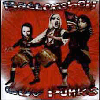
Battershell: Luv Punks - Album Review

Battershell
Luv Punks
(Ng)

Cover Art

The circus has come home to Popopia and we're all invited, courtesy of gurlee-punkers Battershell. The adventurous trio from New York City is back with "Luv Punks", a return to the "non-mundania world of fantasy and frolic". 


The U.S.S. Battershell has witnessed some serious crew changes since the release of their EP "Beautiful Princess of Spit" in 1995, the year they were signed to NG Records. After gigging around New York and touring the U.S. they released their debut full-length album "Sunshine on Popopia" in 1997. Trapped in their urban environment the band: singer/songwriter/guitarist Tammy Lynn Fulkerson, bass/vocals Hannah Head, and drummer Charlie Lauth, sought to escape into a utopia of their own making. Based on Tammy Lynn's personal experiences, the fifteen songs on the new album will probably ring true for the many patriotic Americans raised on country and western music. Reminiscent of The Muffs, Veruca Salt, and, at times, Jane's Addiction, the drawling lyrics and rockin' melodies constitute a pop-punk meatloaf sandwich with a little mayhem on the side. 


While Tammy Lynn has claimed no affinity for Meat Loaf; Johnny Cash, Ace Frehley and Jimmy Page are definitely on her plate. Her impressive vocal range and solid guitar playing have earned Battershell much adulation as they've been showcased at industry festivals and events such as South By Southwest (two years running), Foundations Forum '96, CMJ Music Conference, and the Macintosh Music Fest. Battershell performs two of their songs on the soundtrack for the movie "Ripe", and have contributed a cover of Bow Wow Wow's "I Want Candy" for the Elektra Records one-hit-wonder compilation. 


Although the upbeat energy and bounce of this album is appealing in a Ramones-y kind of way, it all starts to sound the same after a while. And the lyrics are way too literal, as in: "My chords are tangled, this tone really sucks on my guitar. These cheap effects keep on buzzing, pissing me off." The rangy guitar and bizarre sound effects seem very promising, but the high pitched vocals sour the sauce. Water in the whiskey, if ya know what I mean. 


The real gem on this album, however, is the enthusiastic, trans-gendered cover of Billy Idol's hit "White Wedding". Recommended Tracks: "White Wedding", "Dizzy The Tattooed Dog", and the hidden song six minutes into the final track (Battershell's answering machine and a couple of hot little ditties at the end)


By Christine Leonard
Jul 24, 2001

Monday, 23 July 2001

Kittens: Night Danger Album - Album Review

Kittens
The Night Danger Album
(Sonic Unyon)

Cover Art

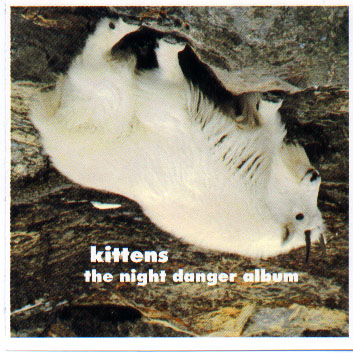
The fierce threesome from Winnipeg is back with The Night Danger Album, featuring cover art of an inverted mountain goat that reminds one of a shot from an old Viewmaster 3-D picture disc.


This album reads like a true Melvins tribute, from the muffled bass and unintelligible lyrics right down to the song titles and the font they're printed in. Funnily enough, Kittens have been kind enough to provide the listener with the lyrics to same said songs, i.e. "Water moccasin, choke on the phone/Jeckyll man, /Jeckyll man, the blindfold of hope" taken from the recommended song "Moosejaw". 


All I can say to that is, "Like stee moanin' Ludlow" (see Melvins " Bullhead"). Still, definitely worth listening to, The Night Danger Album possesses all the Kittens' natural charm and (by now) signature ingredients. With six tracks recorded in only three days, this album retains a certain live performance energy with a touch of Oi and honky tonk thrown into the mix, most prevalent in the song "Honky Tonk Werewolf Song". 


I also recognize the more esoteric final track "Silent Night" which seems to have just been thrown in as filler and yet provides some audio relief with the mellow weirdness of a modern hyper-ballad. All too short, this album is a 6 oz. steak where a 10 oz would have satisfied. Kittens can also be heard on the recently released "Now We Are Five" Sonic Unyon artist compilation.


By Christine Leonard
Jul 23, 2001

Saturday, 23 June 2001

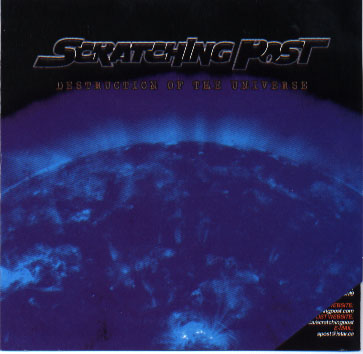
Scratching Post: Destruction of the Universe - Album Review

Scratching Post
Destruction Of The Universe
(Squirtgun)

Cover Art

That's right cats, a brand new Scratching Post has arrived for your enjoyment! Now, let's try not to tear it apart too quickly! The energetic pop-core foursome from London, Ontario are back with their second major effort Destruction of the Universe, the long-time-coming follow-up to Flamethrower released back in 1996. Short and sweet, Destruction takes only a brief eight tracks to accomplish its task, with a quick one-two punch of raw ambition. 


One: girlie rock lyrics dripping from Nicole Hughes' irresistible candy apple lips. POW! Two: massive and crunchy thrash-metal guitar underlying the whole production, courtesy of her Slayer convert bandmates. ZONK! 


There you have it, two sounds for the price of one. If you enjoy Liz Phair, Veruca Salt, Helmet, Slayer, Voivod and/or Kiss be sure and check out these self-professed pinball wizards. Of course, knowing that the driving force behind the band, singer Nicole Hughes, is a fan of Duran Duran and Shania Twain only intensifies the image in my mind of three metalheads shackled to the stage, dying to let their demonic tendencies loose upon an unsuspecting, besparkled and tank-topped all-ages crowd. Insert maniacal laughter here. 


Obviously, she keeps these beasts on a pretty short leash, as they fill in the songs with heavy bits here and there and even manage to break out a little with some scary screams on the final track which lends the hastily assembled album its title. Eager to be signed onto a major US label, Scratching Post ventured south of the border to create the album under the watchful mastery of Phil Nicolo, famed producer of Urge Overkill and Life of Agony. They certainly caught Nicolo's ear, and his influence in the mixing is apparent as you listen to the more feminine vocals surf on top of the waves of power chords without losing any ground. Much like Urge Overkill, the overall energy level is high enough on both sides to maintain a certain equilibrium. 


As I mentioned, this cd only contains eight songs for a total playing time of a mere 25 minutes. The single "Bloodflame" is rather noteworthy, but the material has often been described as sounding "eerily similar." Basically, when I hear this cd (which can easily be done in one sitting) I hear a cash register in the back of my mind. We're talking huge commercial potential here and this album officially puts Scratching Post on the international auction block. Going once...going twice... 


Look for big things from Scratching Post, including a video for "Bloodflame" which is currently in the works for release in April. As well, the band has plans to tour extensively in the spring and summer of 1999. 


Recommended Tracks: 1. Unforgiving Love 2. Bloodflame


By Christine Leonard
Jul 23, 2001

Tuesday, 1 May 2001

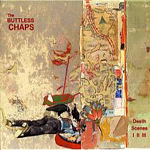
The Buttless Chaps: Death Scenes I, II, III - Album Review

The Buttless Chaps
Death Scenes I, II, III
(Lonesome Cowboy Music)

Cover Art

Tobacco-chewin' tunes for the lonely rambler in all of us. Showdown at the Circle K corral these nouvelle country dusters deliver the goods, with a bit of electric twang thrown in for good measure. The latest and greatest from Canada's favourite bare-assed barstool busters stampedes to a store near you in the unassuming form of an 11-track tribute to roadkill, the adorable fuzzy critters who never made it to the other side of that broken yellow line. A tender subject, but no cut is too rare for these calamitous cattlemen. Death Scenes I, II, III's alternate title might have been Let It Bleed.


Heartbreakingly simple songs, with plenty of banjo accompaniment, are the catalysts for many a romantic prairie reverie. The sweet smell of fresh-cut hay and the scarlet hues of a harvest sunset have been digitized here for your aural pleasure. One listen and you will find yourself transported to flavour country. The presence of Spanish trumpets evokes a Tex-Mex aesthetic, reminding us of bullfights, refried beans (aka. Mexican strawberries = always in season), and lazy, sunburnt siestas. Siesta time indeed, for despite their unsettling appellation, the exposed ones constitute a surprisingly mellow smoke, with 25% less tar than your new country music groups. Rather, they adhere to the Hank Snow, golden-oldie days of country predating Shania and the rest on her inbred, pop-fed kin.


Soft and slow, Dave Gowan's dreamy vocals will lull you into a state of repose faster than you can say "Rhinestone Cowboy." The gentle and contemplative songs on this album blend together until there is almost nothing left to distinguish them from one another. The biggest standout from the mass is "Six Strong Men," the title that answers the burning question: What will it take to get me into church?


Making excellent use of pianos, violins, clarinets, and, of course, euphonium, The Chaps create a wonderfully, warm ambiance that's guaranteed to put their audience at ease. Each tune seems so casual and off the cuff that it would be tempting to assume they were written in an absent-minded flow of consciousness à la Wesley Willis. Yup, just hit the Country Demo button on the old Casio organ, sit back, sip some Southern Comfort and write some poop-kickin ditties about what you did or maybe just thought about doing that very day.


If you're a fan of vintage country music, or you just really enjoyed David Byrne's movie True Stories, be sure to check these dudes out. The Buttless Chaps may not be the fastest guns in the West, but they sure do sit tall in the saddle.


 ( http://www.thebuttlesschaps.com )

RECOMMENDED TRACKS: Six Strong Men, Disco Dancer

By Christine Leonard
May 1, 2001